Showing posts with label modes. Show all posts

Friday, November 26, 2021

Nested Triads in 4ths

 A practical approach to mapping triads comprises four 'nested' chords, each spanning three consecutive strings: ⑥⑤④ / ⑤④③ / ④③② / ③②①. Each successively higher triad root is a 4th above the previous one. With the sole exception of the tritone (augmented 4th) between the IV and the VII chord roots, every chord root is a perfect 4th apart. 

In the image above you can see the structure of the four triads in the VII Zone. Below you can see all the triads belonging to a given key. Because the notes are shown as Roman Numerals, you may position the patterns on any fret position. Roman Numeral I indicates the Tonic of the key, no matter which fret or string it's on. Once you've located a specific position to assign the pattern, play them all in the same key, then in another key, until you've become familiar with the patterns in every key.


Here's notation and tablature to play all the patterns in the key of G:


Friday, October 21, 2011

4-String Modes Rooted on the 6th String, Key of Bb

Here are the same lower string modes in the key of Bb. Notice that the symmetry is clearer in this key;


All contents of this blog are © Mark Newstetter

4-String Modes Rooted on the 6th String, Key of C

The lower four strings are all tuned in 4ths (E-A-D-G from low to high) which yields symmetrical patterns. The following diagrams show all the 4-string modes in the key of C;


All contents of this blog are © Mark Newstetter

4-String Modes, Rooted on 5th String

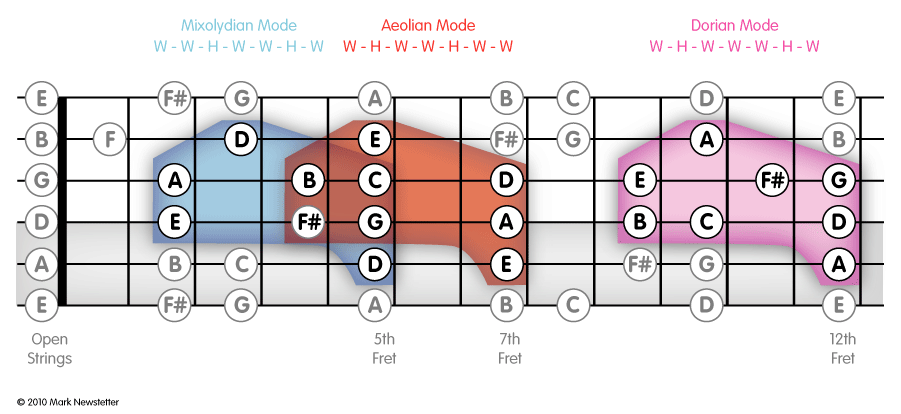
When 4-string mode forms are rooted on the 5th string, they lose their symmetry. This is because the interval pattern of the strings is asymmetrical. That is, the interval pattern of the upper four strings (4-3-2-1, from low to high), the interval pattern is Perf. 4th / Maj 3rd / Perf. 4th, which is symmetrical. However the interval pattern of the four middle strings (5-4-3-2) is Perf. 4th / Perf. 4th / Maj 3rd, which is asymmetrical. So the patterns which span these four strings are asymmetrical.

Interestingly, three of these patterns - Mixolydian, Aeolian and Dorian - though lacking the rotational symmetry of the standard module forms, share the same silhouette;
The diagram above shows the key of G. Below you can see the Dorian and Mixolydian modes in the key of C;
The Ionian and Phrygian modes, which are a symmetrical module in the upper and lower strings, are very different in the middle four strings;
Likewise, the Lydian/Locrian module becomes a mixed bag;


All contents of this blog are © Mark Newstetter

4-String Mode Forms

The simplest single octave mode forms span three strings. We have looked at all of these forms in previous posts, and they are included in the iPhone App, Modes 101. All of the 3-string modes are played starting from the 1st or 2nd finger (or an open string). Now we'll examine some mode forms which span four strings.

It may be more practical within a particular riff to begin the mode on the 3rd or 4th finger, because of the hand position dictated by a previous chord or riff. All the 4-string mode forms begin on either the 3rd or 4th finger, and cannot start with an open string (but may begin with the 2nd finger if the mode includes open strings).

Let's start with the Ionian/Phrygian module spanning the upper four strings. The symmetry is clear;

Notice that the Phrygian mode begins with two notes on the lowest string of the pattern and ends with one note on the top string. The Ionian mode is exactly the opposite.

Next, the Mixolydian/Aeolian module;

These forms overlap in this view. Notice that the silhouettes of the modes are identical. They both begin and end with a single note on the low and high string. Starting on the 4th finger and ending on the 1st.

And here are the 4-string mode forms in the Lydian/Locrian Module on the 4 upper strings;

Dorian Mode, in these 4-string upper forms, would be rooted in the 12th fret or on the open 4th string in the key of C, which is not a very practical position. Below, it's shown in the key of G where it is rooted on the 7th fret;


All contents of this blog are © Mark Newstetter

Thursday, March 18, 2010

Lower string group symmetries

The lower three strings have their own symmetry. The center of this symmetry is a group of tones I like to call 'The Big Box'.
The nine notes of this pattern, with D at the center, are aligned on the 3rd, 5th and 7th frets across the 4th, 5th and 6th strings. Looking at the remaining tones within the lower string group, you can see their rotational symmetry around the big box.

There are two complete mode scales in the big box. Ascending from G and descending from A it can be treated as an ascending Mixolydian mode from G to G, and a descending Aeolian mode, from A to A.

This pattern also fills the space between the Phrygian and Ionian modes on the same three strings;


So all the key of C note position on the lower three strings can be learned by studying these three patterns.


All contents of this blog are © Mark Newstetter

Total Modal Symmetry

The diagram above shows all seven Diatonic Modes. They are shown in the key of C, divided into two groups; Primary Modes and Mixed Modes. The three primary modes are each made up of two intervalically identical tetrachords. The four mixed modes each contain two differing tetrachords. There is symmetry within each of these two mode groups. Study the Whole-step / Half-step patterns of each mode and each group of modes, looking at them from the center outward.

Knowing the tetrachord structure of each mode greatly simplifies the learning process. In addition, the three mirror mode sets we looked at earlier enable you to learn two modes simultaneously. As we've seen, the mirror mode principle organizes the tones of specific modes into symmetrical patterns on the fretboard. This is simply an expression of their innate musical symmetry within the diatonic system.

Ionian  mirrors Phrygian, Lydian mirrors Locrian, Mixolydian mirrors Aeolian, and Dorian mirrors itself.

There's really no reason to treat modes as mysterious, yet many guitarists are confused by them. Part of the reason for this is the tendency for scale patterns to be learned haphazardly. If your study of scales overlooks tetrachords and their symmetry, modes will be baffling.

Wikipedia has an interesting entry on modes; http://en.wikipedia.org/wiki/Properties_of_musical_modes


All contents of this blog are © Mark Newstetter

Wednesday, March 17, 2010

Dorian Mode ( Upper Strings / 3-String Form )

The only perfectly symmetrical mode is the Dorian mode. Based on the second scale degree, the interval pattern of the Dorian mode is;


If you look at this mode from the center whole-step and go both directions from there, you'll see that the intervals mirror each other. As a result of this, the Dorian mode appears in opposition to itself on the fretboard as seen in this diagram;


In the next entry, we'll sum up the overall structure of modes within a given key.


All contents of this blog are © Mark Newstetter

Sunday, March 14, 2010

Lower 3-String Modes


Our next modes are Lydian and Locrian, modes IV and VII, respectively.


These modes are also paired symmetrically. They differ from all other modes in that the central interval in each of them is a half-step. 


All contents of this blog are © Mark Newstetter

More 3-String Mode Forms


The next two modes we'll examine are the Mixolydian and Aeolian modes, the Vth and VIth modes, respectively.

Like the Ionian and Phrygian, these two modes are mirror image interval patterns;


Study the diagram at the top of this post. Notice that the modes are geometrically opposite.

As with all patterns on the guitar, there are various forms for playing each mode. The specific forms in these diagrams are chosen because they clearly illustrate the symmetry of the patterns. This is a useful way of learning modes, because you can learn two at a time while also achieving a better understanding of their tonal character.

Remember that symmetry is an inherent element in the diatonic system. ( Review the blog entry on this subject ) Just as specific tones are arranged in geometrically opposing pairs, so are modes.


All contents of this blog are © Mark Newstetter

Thursday, March 11, 2010

Modes ( 3-String Forms )


When you play a major scale you are in fact playing a mode. Any time the tones of a key are played in sequence spanning an octave, it's a mode. For example; the sequence C D E F G A B C, usually referred to as a major scale, is also known as the Ionian Mode. The sequence D E F G A B C D is the Dorian Mode, E F G A B C D E is the Phrygian Mode.

Modes are useful for playing harmonies and are important in understanding how melodies work. Songs don't all begin and end on the tonic.

Two modes are shown above; Ionian and Phrygian. Notice that the note positions in one are the exact opposite of the other. The interval structures of these two modes are mirror images of each other;


Each mode contains all the tones of the key, but they each begin and end on a different tone. Play each mode and you'll find that they have their own individual musical character. These two modes harmonize because they are a 3rd apart. If two guitars each play one of these modes in synch with each other, the result will be a harmonious scale.

There are seven modes, one for each scale degree. Below is a list of the modes and their interval structures;

I = Ionian Mode;

C D E F G A B C / W W H W W W H

II = Dorian Mode;

D E F G A B C D / W H W W W H W

III = Phrygian Mode;

E F G A B C D E / H W W W H W W

IV = Lydian Mode;

F G A B C D E F / W W W H W W H

V = Mixolydian Mode;

G A B C D E F G / W W H W W H W

VI = Aeolian Mode;

A B C D E F G A / W H W W H W W

VII = Locrian Mode;

B C D E F G A B / H W W H W W W

-------------------------------------------------------------

We'll look at the symmetrical relationships of the other modes in the next posting.


All contents of this blog are © Mark Newstetter

Friday, September 18, 2009

Black Keys /Accidentals in C


There are seven tones in the key of C (as there are in all 12 keys), these are the natural tones. And since there are twelve tones in the entire system, five tones remain. The black keys of the piano are those five tones not belonging to the key of C. These tones are the sharps or flats; C#/Db - D#/Eb - F#/Gb - G#/Ab - A#/Bb. On the guitar these same five tones are aligned at the 11th fret and also distributed across the fretboard in the symmetrical system we've been mapping out in this blog. These 'black-key tones' are also known as the accidentals in the key of C.

The natural tones align in three axis positions on the fretboard between the open strings and the 12th fret; the Phrygian Axis at the open strings (and 12th fret), the Aeolian Axis at the 5th fret, and the Dorian Axis at the 10th fret (see 'What is Fretography'). But there is one more axis; the axis formed at the 11th fret by the alignment of the 'black-key tones.'

Naming this axis is not so simple. We could call it the Black Key Axis, or the Sharp and Flat Axis, or the Accidental Axis But it would be better to use a term that is more in keeping with the names we've assigned the other three axes, which are each based on a Diatonic Mode.

Taken as a group, the five black-key tones can be described as the 5 flats of the key of Db, which is the first of three keys which incudes these tones; Bb, Eb, Ab, Db, Gb (with C and F remaining to complete the key). The two other keys which include these tones are: Gb - has all five plus the addition of Cb (which is enharmonic with B), and the key of Cb - all 7 tones are flats.

The black keys can also be thought of as C#, D#, F#, G# and A#. which can in turn be found in three keys which are enharmonic with the three flat keys we've just described; B (enharmonic of Cb), C# (enharmonic of Db), and F#(enharmonic of Eb).

We'll use the key Gb as the context for this Axis because it comports with the symmetry principle better than F#. In doing so we are choosing a key signature which is a b5 above C, as opposed to F# which is an augmented 4th above C. Theoretically, a flat 5 trumps a sharp 4. Thinking of it as the Secondary Aeolian Axis places it at the center of another layer of symmetry, as we shall see in the next blog post.

In Fretography we the Axis of tones not belonging to the key in which we are working as the Void Axis. The Secondary Aeolian Axis of the key of C is simply the Aeolian Axis in the context of the key of Gb. In C, it is the only fret position made up entirely of tones outside the key. In Gb it is at the center of the diatonic symmetry. Each key, then, contains a Secondary Aeolian (or Void) Axis on the fretboard based on the position between its Dorian and Phrygian Axes.

In music theory there is always more than one way to describe a given concept. For example, The 'Major Scale' is also known as the 'Ionian Mode.' The tones of an A minor 7th chord can also be described as an inversion of a C 6th chord. It all depends on context. For that reason, some structures in Fretography can have more than one name.

__________

The five black-key tones also comprise a pentatonic scale based on the same interval structure as that typically used in rock and blues. If you're familiar with pentatonic scales on the guitar, play the black-key tones shown on the diagram above and you'll recognize the patterns.

But pentatonic scales are not just for playing rock and blues, and the black-keys needn't only be seen in the context of pentatonic scales. As important as it is to know where the natural tones are, it's equally useful to know where they are not. The pattern of black-key tones, studied in their natural context as sharps and flats, will enhance your fretboard comprehension.

We'll look at more theoretical possibilities for the black-key tones in the next post.

The diagram above shows all the positions of the black-key tones, and also includes Cb and F (in gray) which complete the key of Gb.


All contents of this blog are © Mark Newstetter