Showing posts with label theory. Show all posts

Thursday, July 20, 2017

Combining 'Sym-Ex.' Major 7th Arpeggios

The image above shows the two Symmetrically Extended Major 7th arpeggios, each in two different forms. On the left you see the IV/II in the middle voicing (purple) overlapping the upper I/VI (yellow). On the right the middle voicing I/VI (blue) overlaps the IV/II upper voicing (orange).

If you were playing this in the key of C, with "II" placed on the 5th fret of the 5th string, the form on the left could be written:

In the key of Eb, the form on the right would be positioned with "VI" on the 3rd fret of the 5th string:

Keep in mind that the Roman numerals in the diagrams indicate the key degrees of each arpeggio. These numerals remain the same for every key. Since there are two identical Extended Major 7th arpeggios (or minor 11ths) in each key, the only way to determine their relative positions is to decide which is the I/VI and which is the IV/II.

Also, notice that these arpeggios happen within specific "Zones" as detailed in my book "Fretography."

Another interesting combination is the lower forms with the upper forms of the same scale degree:
Here, you'll see that in the lower forms — rooted in the 6th string — both the I/VI and the IV/II are connected to the upper forms in the same geometry. 

We'll place the first grouping in the key of C as shown in the notation above. The next, we'll put in the key of G, as per the notation below:

Look carefully at the notes in both above examples. You'll notice they are the same. But their context it different within the key and will result in different possibilities in each depending on the additional chords and riffs in a particular piece of music.

Here's what they sound like ...

 (Low A minor 11th Arpeggio - ascending and descending) 


 (High A minor 11th Arpeggio - ascending and descending) 

Because this form can exist in an identical form within two different tonal contexts, it is a dynamic bit of riffage to have in your vocabulary.


Monday, March 2, 2015

Superzone 3rds

There are two "Superzones" on the fretboard; the Phrygian and the Aeolian. In any key, the Phrygian Superzone  runs from the Phrygian Axis to the Aeolian Axis – that is; the fret position on which the notes on the 1st and 6th string are the 3rd key degree (Phrygian) and the 6th key degree (Aeolian). In the key of E, for instance, the Phrygian Axis is the 4th fret because G# is the 3rd key degree of that key.

Below is a diagram of all of the 3rds within the Phrygian Superzone in the key of E ...
Major 3rds are shown as green, minor 3rds are amber. Notice the minor 3rds in the "3rd rail" (the 2nd and 3rd strings) are the same shape as the major 3rds everywhere else.


... Phrygian Superzone 3rds, ascending and descending


Now lets look at the Aeolian Superzone, this time we're in the key of B. In this key the Aeolian Superzone occupies the same fret span as the Phrygian Zone/Key of E in the above example. Compare the two patterns ...

... Aeolian Superzone 3rds, ascending and descending


You may want to focus on the positions of the major 3rds (I, IV, V) in each of the patterns. Notice in the Phrygian zone, that lower five major 3rds form a symmetrical sequence starting with A Major: IV - V - I - IV - V. See how central the V - I - IV grouping is.

In the Aeolian zone there are four major 3rds in the lower group, aligned in pairs starting with B Major: I - IV - V - I.

Look for the groupings of minor 3rds as well and practice them, and the major 3rds independently of one another. Be careful with your fingering so that you can feel the shapes of the double-stops as you play. Major 3rds may, at one time or another, be fingered 1-2, 2-3, or 3-4. Minor 3rds are fingered 1-3 or 2-4 outside the "3rd rail" (the 2nd and 3rd strings)  and 1-2 or 3-4 in the 3rd rail.


All contents of this blog are © Mark Newstetter

Monday, October 7, 2013

The Language of the Diatonic Guitar

Sources of confusion in any endeavor must first be identified before the confusion itself can be dealt with. If you find the guitar fret board confusing; why? If you are confused by basic western music theory concepts, then it's likely that same confusion will make its way into your study of the guitar.

You may think that the concepts and terminology of music theory are too difficult to bother with, but remember that — in the western diatonic system of music, which is what you are working with if you play the guitar (whether you know it or not) — fundamentally there are only 12 major keys and only 7 notes in each key. Think of it like the 12 months of the year and the 7 days of the week. These are not huge numbers.

The following terms are essential concepts in diatonic theory;

Tonic, Supertonic, Mediant, Subdominant, Dominant, Submediant, Leading Tone

... They are the Scale Degrees. They are, more or less, equivalent to the following;

Do, Re, Mi, Fa, Sol, La, Ti ... 

I, II, III, IV, V, VI, VII ...

C, D, E, F, G, A, B ...


Here are simple definitions;

Tonic -  The tone upon which a key is based. Note number I. C in the key of C major.

Supertonic  - The tone a whole step above the tonic. Note number II. D in the key of C major.

Mediant - The tone a third above the tonic. Note number III. E in the key of C major.

Subdominant - The tone a 4th above the tonic. Note number IV. F in the key of C major.

Dominant -  The tone a 5th above the tonic. Note number V. G in the key of C major.

Submediant -  The tone a 6th above the tonic. Note number VI. A in the key of C major.

Subtonic - The tone a minor 7th above the tonic as well as the same note a whole step below the tonic. Note number bVII. Bb in the key of C major.

Leading Tone -  The tone a major 7th above the tonic as well as the same note a half step below the tonic.  Note number VII. B in the key of C major.

Notice that there are two 7ths; the Subtonic and the Leading tone. The importance of this distinction becomes clear, for instance, when you switch from playing a major key love ballad or folk song to playing a raunchy blues based riff. The major 7th (Leading Tone) is the norm outside "blues based" music, whereas the Subtonic is the norm in blues. This is a gross simplification, but it should illustrate the concept.

Hierarchies ... The Tonic and the Dominant are the landmarks in the system — Roman numerals I and V, respectively. You are already familiar with these two tones. Play any typical major barre chord, G major rooted on the 3rd fret of the 6th string, say. 


The lowest pitched note is the root of the chord, the next note up in pitch is the 5th. If you are in the key of G this G barre chord will the the Tonic Chord and the root and 5th of the chord will also be the Tonic and Dominant tones of the key.

If you play a G7th by releasing your 2nd finger and moving your 4th finger to the 6th fret of the 2nd string, you are playing what is also known as a "Dominant 7th" chord. This is not the same as a "Major 7th" chord. The difference between the G major, G Dominant 7th (usually referred to as G7th) and the G Major 7th chords is seen in the diagram which follows;


Each of the chords above have their own story to tell about where they come from and how they like to be used.

G Major chord


G Dominant 7th chord


G Major 7th chord


The G Major chord is a triad. It comprises three tones: G-B-D,  though there are three instances of the Root (G), two 5ths (D)  and one 3rd (B) amounting to six notes. This chord could be the Tonic chord in the key of G, the Subdominant chord in the key of D, or the Dominant in the key of C. When a 7th is added to the triad, it will be either a G Major 7th or a G Dominant 7th depending on which key degree it is positioned.


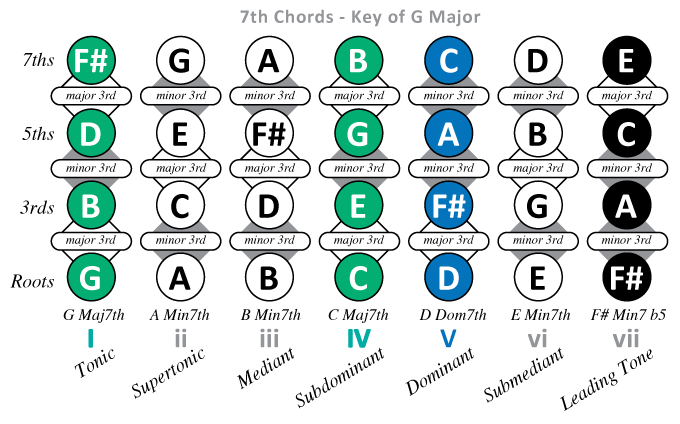
If a 7th chord is rooted on the Tonic (I) or the Subdominant (IV) it will be a Major 7th chord. If it is rooted on the Dominant (V), then it will be a Dominant 7th chord. This is true in every diatonic major key. It works this way because of the distribution of major and minor thirds within the key;
Study the diagram above carefully. Notice that the I and IV chords have the same interval structure of major and minor 3rds. Notice how the interval structure of the V chord differs from the I and IV.

The remaining chords are three "Minor 7ths" (ii, iii and vi) and a "Minor 7 flat V" (vii) — also known as a "Half Diminished" chord. 

Here are the 7th chords of the key of G major;

And here are the 7th chords of the key of D major;

The structure of each chord is actually only a starting point. For instance; although the I and IV chords are the same internally, their different positions in the key will potentially lead to differing harmonic and melodic possibilities when improvising around each of them. 

All contents of this blog are © Mark Newstetter

Friday, October 28, 2011

The Center of the Fretboard

Have you ever pondered the question of where exactly, is the 'middle of the fretboard?' Maybe 'center' is a better word than 'middle'. One certainty is that there is no clear comprehensive answer. The best answer is probably;"It depends."

If what it depends on is the Diatonic Key, then the answer can be more precise;

In Fretography, the center of the fretboard is considered the center of the key (and vice versa). So, in the key of C major/A minor, the center of the fretboard is the 5th fret between the 2nd & 3rd strings (G and B string). The 2nd and 3rd strings form what is, in Fretography, the "Third Rail." This refers to the 3rd interval between those strings. Since the tuning relationship between these strings is unique, they are given special focus. They become the pivotal strings around which all the note patterns revolve. The principal of rotating symmetry becomes quite clear when you focus on this position before exploring the rest of the fretboard.

The four encircled tones in the diagram above are the four compass points to the rest of the fretboard. In the key of C, they are B-C-E-F. The 7th, Tonic, 3rd and 4th of the key, respectively.

Below, the same pattern in the key of D;

Notice that the four center notes are now C#-D-F#-G. These are the 7th, Tonic, 3rd and 4th of the key.

This cluster of tones, VII - I - III - IV  are positioned on a fret which forms an Axis.  Notice that there are three unique Axis frets on the fretboard in the above diagrams. There are four actual Axes, but in both of the keys shown above, there are two with identical note names; EADGB. These matching fret positions can be considered the same theoretical Axis.

If we ignore the far right Axis in the first diagram (Key of C, 12th fret) and the far left Axis in the second diagram (Key of D, Open Strings), then we have a set of three Axes, with the target notes in the Center Axis.

This Axis is shown below with Roman numerals which represent the scale degrees which apply to every key, regardless of which fret position the Axis is placed;

The four notes of the Center Cluster can be found in three places within the span of the four top strings;

The same notes, an octave lower are positioned as shown below with blue targets;

Let's see where these notes fall on the piano keyboard. The diagram below shows the BCEF clusters in three octave positions on the fretboard and piano.  Also shown is the very low EF 'semi-cluster' - the two lowest notes on the guitar (in grey), as well as the high BC semi-cluster on the 7th & 8th frets of the 1st string (yellow) and the low EF semi-cluster on the 12th & 13th frets 6th string (blue);

These notes are not only the tonic, 3rd, 4th and 7th of the key – as such, they are also the half-step positions. Learn the positions of these four notes. They are the compass points which show the way to the whole system.


All contents of this blog are © Mark Newstetter