Showing posts with label staff symmetry. Show all posts

Wednesday, November 23, 2011

Voyage to the Bottom of the Staff - Part 2

The Grand Staff is the standard system for written piano music. As a guitarist you may want to be able to read music written this way. If you already read guitar notation, you are used to reading in treble clef. You are also used to playing pitches an octave lower than their standard pitch because guitar music is written an octave higher than it sounds. So, reading in standard pitch, as you'll have do when reading music written for piano or voice, requires a change of attitude.

The diagram above shows all the notes on the grand staff in a symmetrical pattern. We use symmetry in the Fretography method because it strengthens cognition. When you study the note-pairs in the symmetry you'll be able to see connections between notes even when they are far apart in pitch. This is useful whether you are reading in standard pitch, or – more typically for guitar – transposed in treble clef.

The symmetries of the individual treble and bass clefs have been explored in previous posts. Now we are looking at the overall symmetry of the combined bass and treble staves. Pay special attention to the notes of the open strings on the staff as indicated at the right of the diagram. Of course these same pitches are found in various places on the fretboard. Learn to associate the each note on the staff with all of its fretboard positions starting with the notes of the open strings, then adding C and F.

Notice that C is the central note within the grand staff, and that middle C can be written one leger line below the treble staff and/or one leger line above the bass staff. Also note that the positions of B and D are mirrored between the two staves, as are E - A, and F - G.

Below is a comparison of the positions of middle C on the fretboard, the grand staff (standard pitch) and transposed for guitar on the treble staff;
We should mention that there actually is a special treble clef – the octave-down or octave-dropped treble clef – which serves the purpose of indicating that the notation is transposed;
The little 8 hanging from the bottom of the clef indicates that the notes on the staff are played an octave lower than written. You will occasionally see this clef used for guitar music, though the transposition is usually assumed even when a standard treble clef is used.

The more familiar you are with the positions of notes on the fretboard, the easier it will be to transpose.

Try playing melodies you already know in different octaves. One difficulty is that you may need to employ different fingerings when playing the same melody in a different octave. If you take a systematic approach, this will be less of an issue. The usual reason for fingering changes is that in one octave range, the melody may be within the four lower strings, and when it's transposed it crosses the 2nd and 3rd strings (what I call the 3rd rail.), thus requiring an adjustment to compensate for the different relative tuning between those strings.

Here's a simple rule; When you are ascending from the 3rd to the 2nd string, you must shift up one fret to maintain the same interval pattern of the lower 4 strings. When you are descending from the 2nd to the 3rd string, you must shift down one fret. In other words; when you go up you add a fret ... when you go down you subtract a fret.

We'll look at the shift between the 2nd and 3rd strings in greater detail in a future post.


All contents of this blog are © Mark Newstetter

Tuesday, November 22, 2011

Reading Notation: Voyage to the Bottom of the Staff

Prepare yourself for a geeky look at a slightly obscure aspect of music theory for the guitar. What you are about to read, should you proceed beyond this introduction, will require both courage and patience - traits which are not often found in the same individual. But if you are one of those rare guitar players who is willing to stretch your synapses, read on.

Guitar music is usually written in the treble clef, transposed on the page an octave higher than its true pitch. For instance, the note pitch of middle C falls here in guitar notation;
... and here in piano notation;

Both of these notes are the same pitch on their respective instruments when played as written, but the piano follows the standard, so notation for the guitar is actually written an octave higher than standard. What this means in practice is that music written specifically for guitar will take into account the proper octave transposition - so the notes will be in their intended pitch, but if you play music written for piano or voice on the guitar, you will sound an octave too low, so you have to compensate by playing an octave higher than you would if the music was written for guitar.

For example; here is a melody written for piano;
First example.
... and the same melody written an octave higher on the staff for guitar but sounding the same pitch as if they were played on the piano from the example above (including tablature for reference);
Second example.
Both examples above will sound the same if played as written for each instrument. In other words, the pitch of the notes indicated on the tablature is actually the pitch of the notes indicated on the piano version of the melody in the first example. As you can see, the guitar notation places the notes higher on the staff. Notice that the Gs on the piano staff are two ledger lines below the staff.

If you were to play the melody notated for the piano in the first example as if it were written for guitar it would sound an octave lower;
Third example.
However, this would be wrong if you were trying to play what the piano was intended to play, since the intended pitch of the notation for the piano is an octave higher than the tablature shown here. As a guitarist reading notation for piano, you have to make the mental shift to the octave shown in the second example above, so it sounds an octave higher.

Here's the melody one more time with tablature indicating its 'true' pitch;
Fourth example.
As you can see, the true pitch of the notation of this melody on the fretboard is around the middle of the guitar's range – but low enough on the treble staff that going lower would require using the bass clef.

Here is the lowest note on the guitar (the open low E string) as written for guitar;
... and here is the same note as written for piano (its true pitch);
Piano music is written on the 'grand staff' which includes bass and treble clef.
As you can see, the open low E string on the guitar is quite low. So - as a rule - guitar notation is shifted an octave higher on the staff.

Now, suppose you have sheet music written for piano which you want to play on the guitar. You may have to make some changes in terms of chord voicings. But do you really have to re-write everything onto the treble staff, or should you just read it as it's written?

The great jazz guitarist and composer Johnny Smith is a firm believer that guitarists should read and write music on the grand staff, rather than transposing to the treble staff. Though this is not a majority view, there is certainly some merit to the idea. Being able to read in the bass clef has several benefits. Aside from being able to read piano music and play it on the guitar, you will be conversant with bass players, who read in bass clef. Interestingly, because the bass is so low, it also transposes, so the bass sounds an octave lower than written.

While the treble clef is a stylized letter G, The bass clef is a stylized letter F. The two dots on the clef surround the line of the staff assigned to the note F. Below you see the names of the notes on the bass clef;
Notice that the central note of the bass clef is D, also that E is one leger line below the staff and C is one leger line above.

The diagram below shows the symmetry of the notes on the bass clef;

Interestingly, the symmetry of the bass clef is centered around the note D, just like the Fretographic symmetry of the guitar fretboard.

Notice that the true pitch of the open strings of the guitar brings them will into the bass staff. Only the notes of the open 1st and 2nd strings are placed above the staff.

Now let's compare the bass symmetry with that of the treble staff;

(To review the treble staff symmetry in depth - read the previous entry here)

The respective symmetrical note-pairs are shown in boxes above the treble and below the bass staves. The diagonal dotted lines in the middle are connecting the equivalent central notes of the two staves to draw attention to their symmetrical positions across both staves. The note positions of the open strings are indicated to the right. Notice that the upper part of the bass and lower part of the treble staff include the same notes. For instance; the lowest E on the treble staff (below the 3rd leger line) is actually the same pitch as the E in the center of the bass staff. Likewise, the highest A indicated on the bass staff (above the 3rd leger line) is the same pitch as the A in the middle of the treble staff.

In piano music, the bass staff is used to indicate notes which are played with the left hand on the piano. The treble staff indicates notes played with the right hand. The two staves may therefore overlap so that the left hand can occasionally move into the territory of the right hand and vice versa.

Being aware of the note relationships on the staff, with or without the guitar at hand, will widen your musical horizons. Spend some time just studying the treble and bass staves. Memorize the note positions so that you can close your eyes and picture them. That's the first step to being able to connect the concept of music as sound with music as written language.

Still with us?

To be continued ....


All contents of this blog are © Mark Newstetter

Wednesday, November 9, 2011

Reading Notes: Staff Symmetries

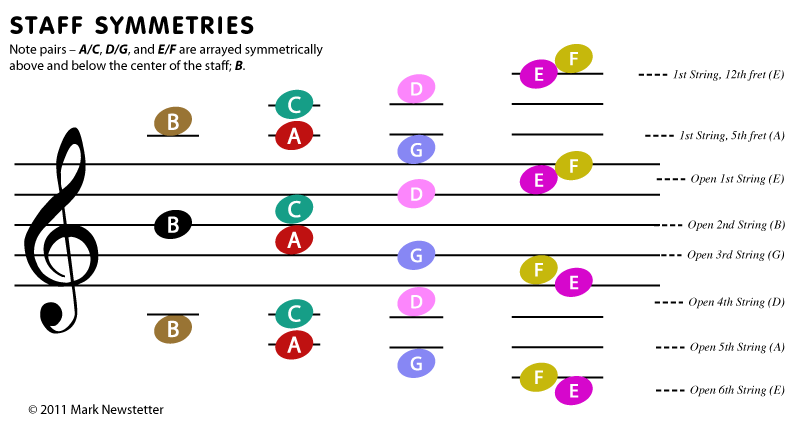
The natural key symmetry of the diatonic treble staff is an interesting counterpart to the symmetry of the same diatonic key on the fretboard. We have examined the fretboard's symmetry in a number of posts. Now we are seeing how the specific patterns of notes on the staff have their own rules of symmetry. Whereas on the guitar fretboard (and the piano keyboard) the central note is D, on the treble staff, B is the central note - or fulcrum around which other notes are arrayed.

The symmetry of the fretboard is based on the intervals within the key. The pattern of half-steps ascending from D is a mirror image of the intervals descending from D. On the treble staff, the note B is the central note from a graphical or visual perspective.

When we look at the staff, there is no indication where the whole-steps and half-steps are to be positioned. Just a set of five lines and the spaces between them;
The seven notes of the key of the natural key, ABCDEFG, are assigned to these lines and spaces, sequentially from the bottom up;
Notice that the note in the space below the staff is D and the note in the space above the staff is G, and that B is the central note on the staff. 

Additional notes are added above and below the staff when higher or lower notes are to be played. Short lines (leger lines) are used for individual notes;
Remember that you always have a reminder of where the note G is on the staff, because the clef itself is actually a stylized letter G. The belly of the clef encircles the G line on the staff;
Since the notes are alphabetical, it's only logical that we tend to think of them in that order. The ascending scale is usually the first exposure we have to music theory. Chords are thought of as starting with the root note and rising from there. Of course, scales descend as well, and chords don't have to be played from the lowest note first. Notes can be played in any order at any moment.

Here's another way to look at the way notes are arrayed on the staff; instead of a linear progression, you can think of the staff as a symmetrical array with the note B as the fulcrum.

If we look at the staff from the center first, the symmetry emerges;
Look carefully at the diagram above. study the symmetrical relationships of the notes from the center up and down. Study the positions of the note B, then the notes A/C, then D/G, then E/F. B forms its own symmetry, A and C are symmetrically arrayed - C is one leger line below the staff, A is one leger line above ... A is two leger lines below the staff, C is two leger lines above. D/G and E/F follow the same principle.

Below is another version of the same diagram. The notes are connected by dotted lines which clarify the symmetry;

Learning these connections will help you identify notes on the staff more quickly.


All contents of this blog are © Mark Newstetter