Friday, October 21, 2011

4-String Mode Forms

The simplest single octave mode forms span three strings. We have looked at all of these forms in previous posts, and they are included in the iPhone App, Modes 101. All of the 3-string modes are played starting from the 1st or 2nd finger (or an open string). Now we'll examine some mode forms which span four strings.

It may be more practical within a particular riff to begin the mode on the 3rd or 4th finger, because of the hand position dictated by a previous chord or riff. All the 4-string mode forms begin on either the 3rd or 4th finger, and cannot start with an open string (but may begin with the 2nd finger if the mode includes open strings).

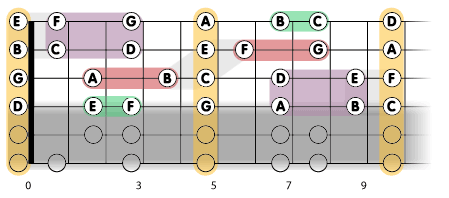
Let's start with the Ionian/Phrygian module spanning the upper four strings. The symmetry is clear;

Notice that the Phrygian mode begins with two notes on the lowest string of the pattern and ends with one note on the top string. The Ionian mode is exactly the opposite.

Next, the Mixolydian/Aeolian module;

These forms overlap in this view. Notice that the silhouettes of the modes are identical. They both begin and end with a single note on the low and high string. Starting on the 4th finger and ending on the 1st.

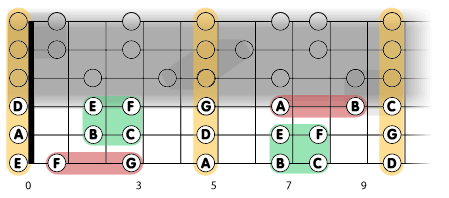
And here are the 4-string mode forms in the Lydian/Locrian Module on the 4 upper strings;

Dorian Mode, in these 4-string upper forms, would be rooted in the 12th fret or on the open 4th string in the key of C, which is not a very practical position. Below, it's shown in the key of G where it is rooted on the 7th fret;


All contents of this blog are © Mark Newstetter

Friday, May 20, 2011

Symmetrical Blocks

Here's another Fretography exercise which brings out the diatonic symmetry of the four top strings in the key of C.

The diagram above shows all the notes of the upper string group from the open strings to the 10th fret. The note positions are highlighted in colors which correspond with their intervallic symmetry. Below is notation for playing the indicated blocks in a symmetrical sequence. The notes of the Axis positions (amber verticals) are not included in the exercise, but are shown for reference.
The purpose of an exercise like this is to visualize the note positions between the axes. Notice that each side of the overall pattern spans four frets. All the notes of the top four strings which fall between the axes are accessed within these two positions. This is simply a way of learning the positions of the natural tones which is not based on a scale pattern, but rather - upon a symmetrical array.

The diagram below shows the same kind of symmetry within the lower 3-string group.
Here's the notation for playing the lower string pattern;


All contents of this blog are © Mark Newstetter

Monday, December 6, 2010

Modes 101

What are modes and why does it matter?

Understanding the relationship between the guitar and the diatonic system would be significantly more difficult without an understanding of modes. In a sense, the seven diatonic modes are key to the fretboard.

This is true because of the way the modes are aligned within the fretboard's systematic grid of strings and frets. Something which is widely misunderstood.

Keep in mind that everything you play on the guitar can be understood better if you can recognize the modal elements in the music. If that last sentence is puzzling to you, consider that you already are using modes if you are playing any scale. If you play a major scale you are in a 'major mode.' If you play a minor scale you're in a 'minor mode.'

You already know two modes. Now you need to learn the other five. And remember ... it actually gets easier.

In the next post we'll revisit modes from a really fundamental place. Meanwhile, you can review some earlier posts on the subject ... herehere, here, and here.

Monday, September 20, 2010

Double Helix Pattern (Tritones and Major 3rds)


The C and E at the 5th fret comprise a major 3rd. B on the 4th fret combines with F on the 6th fret to form a tritone. Study the diagram and notation above. Think of the 5th fret as the starting point, notice the symmetry.

This is an essential exercise in Fretography. The fingering of the pattern is indicated by the italic numbers above and below the notes. The first double-stop, C-E, is played at the 5th fret with the 2nd and 3rd fingers, the second double-stop , F-B, requires the 1st finger on F and the 4th finger on B, 4th and 6th frets respectively.

In each of the double-stops, the right hand thumb plucks the lower string and the index finger plucks the higher.

Play it slowly and be careful to follow the indicated fingering. 

Also, study the symmetry of the pattern carefully. Notice its relationship to the surrounding note positions within the upper four strings, particularly the two BC/EF clusters in the upper left and lower right of that part of the diagram. Then study positions of the remaining three tones: ADG. You'll see that the all the positions of the A's and the G's are exactly opposite, and the Ds form their own rotational symmetry.


All contents of this blog are © Mark Newstetter

Sunday, September 19, 2010

The Philosophy of Fretography - Part II

Here are a few concepts which are essential to, and form the basis of the Fretography method;

- Symmetry is inherently part of the standard tuning of the guitar.

- The study of the fretboard begins at the 5th fret (not the nut).

- The symmetries on the fretboard, which correspond with those of the standard diatonic system, are centered around the 5th fret.

- The key of C is the template for the patterns in Fretography which, once learned, can be applied to every key.

- The three axes in the key of C (Open Strings=EADGBE/5th fret=ADGCEA/10th fret=DGCFAD) and the positions of the natural half-steps (B-C and E-F ) should be learned first.

- The four top strings (DGBE), as a group, comprise one aspect of the symmetry, the three bottom strings (EAD), as a group, comprise another aspect. These two symmetries are studied separately, then combined. These lower and upper string groups can be thought of as analogous with the left and right hands of the piano, respectively.

- Scales, modes, double-stops, triads and extended chords are all found in symmetrical positions.

- Additional symmetries are present, which are learned once a satisfactory comprehension of the above concepts has been achieved.

Regardless of the style of music being played, the mapping of tones in Fretography remains consistent. Just as the pattern of black and white piano keys is no different whether one is playing Ludwig van Beethoven or Thelonius Monk, Fretography can be applied to classical, jazz, rock, folk, blues etc.


All contents of this blog are © Mark Newstetter

Tuesday, September 7, 2010

The Philosophy of Fretography

One of the dangers of challenging the norm in any field is being misunderstood. The salvation from this fate, should it befall one, is the realization that the 'norm' is also misunderstood. Since no one really understands the norm, it's not abnormal to be misunderstood. That people don't understand something doesn't say too much about the truth or falsity of that thing.

Most beginners don't understand the way the fretboard really works. Not just from a mechanical, physical perspective, but a musical one as well. Presented with a diagram showing, say, the positions of the notes of the key of C on the fretboard, most would say that there doesn't appear to be a discernible logic to the positions of the notes.


What one comes to understand is that what is 'discernible' may not be obvious. You have to know how to look at things.


The trick is to have a reason for choosing a particular way of looking at something. Music is not merely based on a set of arbitrary choices. The fixed tonal relationships of the diatonic system reflect natural harmonic principles. When you hear music, you are sensing vibrations (and you are vibrating). These vibrations are recognized as 'music' because they follow identifiable patterns.

If you watch ocean waves rolling to the shore, you can see complexity in a single wave.

Each wave is really a combination of smaller waves. The white foam at the crest of a wave is where turbulence forms to scatter the light enough to turn transparent water opaque. Millions of tiny waves within the bigger wave. The waves come in rhythmic patterns. Some waves are smooth and don't break until they hit the sand. Some waves break before reaching the shore and are absorbed into bigger waves.

This is the ocean singing.

Music is streams of invisible waves, no less real than those in the ocean, which fill the air and set your tissues vibrating in sympathy. There is symmetry and structure inherent in the experience of music, so there is symmetry and structure in the musical tones as they are arrayed on the fretboard. That it appears at first to be a random array is a matter of perspective. There is, of course, randomness within order,

......

I began playing the guitar at age 9, had two formal lessons and decided to find my own way with the instrument. Consequently I took what I think of as 'The Long Slow Path.' What I had, and hope I still have, is diligence.

I also had somewhat formal music training in the New York public schools I attended, in which I learned to play the recorder and the viola. My mother, and some aunts, uncles and cousins played piano, so I learned a few things from them. I felt prepared to figure out the fretboard using the theory I'd learned in school, the left hand technique I was acquiring on viola in Junior High, and the chord structure I studied on the piano.

I could play scales, picked up chords quickly, and figured out how to sing and strum in two different rhythms at once.

But, like most guitar players, I avoided written music of any kind. But, I enjoyed training my ear to match the tones I'd hear on records with the guitar as I played. It was a great puzzle to try and solve.

That's where it gets confusing.

That the guitar fretboard is somewhat puzzling is common knowledge - especially among novice guitarists. The guitar student has to make sense of what seems to be an almost random invisible array  of notes on the grid of the fretboard.

First of all; it's facing the wrong way! You have to be curious to play the guitar, because it plays hard to get. You can't get face to face with the guitar when you play. Because it's difficult to reconcile the 'upside-down' view one has of the fretboard when playing with the way it's represented on the page, reading for the guitar is a challenge for most students.

If you play for a while, you'll likely reach a point when you'll want to know something about the music theory you've avoided. Especially if you find yourself jamming with people who play other instruments.

Since players of other instruments aren't faced with the convoluted maze of fingering patterns that guitarists have to wrestle with, they have more time to come to terms with the link between notation and vibration. You'll probably be the worst reader in the room. You may end up having the piano player tell you the names of the notes your playing.

Avoidance is not a solution. Yet there are no shortage of workarounds available. Methods based on short cuts. Tablature is the most common short cut. No question that tablature is useful. It's a great form of short-hand. But it doesn't translate. Only a guitar player can make sense of tablature. Players of other instruments read the same basic standard music notation, not tablature. It's a given that if you take piano lessons, or violin lessons, or saxophone lessons, that you'll be taught to read notation.

Not so for the guitar. Students know that lots of famous guitar players get by just fine with little or no formal music theory. Guitar teachers, if they read music themselves, have to accommodate students who are hooked on tablature before they walk in the door.

Where tablature falls short is that it reveals essentially nothing about the relationships between the fret and string positions of notes and their musical identities, either in terms of tonality or rhythm.

Interval relationships are clear in notation. The timing and dynamics of notes is clear in notation. And notation is shared by many many instruments, bringing the guitarist 'into the fold.' Also, because notation is a true language, not merely typography, it can be verbalized and used to enhance communication between players. Tablature can't be read off the page verbally to coherently express the musical ideas it is supposed to represent. All you'd have is a series of string and fret numbers, which would be as meaningless to players of other instruments as the tablature itself.

Tablature does nothing you can't do with notation, though it does provide you with what amounts to a set of map coordinates which simplifies the process of knowing where to put your fingers and which string to pluck in what sequence. Sure it works as advertised, but that's not all there is to music, and the more you play, the more you begin to realize that.

Now, if tablature is an inadequate method of written guitar music, and you want to learn standard notation for the guitar while staying sane, what's the best way to go about it?

The classical method is basically to learn the notes in each fret position from the open strings to the 1st fret, to the 2nd fret, and on up, one by one. Become familiar with the open string position, then the next hand position, then the next. So that you become intimately familiar with the notes of the first three or four frets before moving up a fret.

... Though this works for millions of people, it's somewhat tedious to learn this way. And you never really get a clear picture of the overall note array on the fretboard.

This wouldn't matter if the fretboard was devoid of any recognizable symmetry in the way the notes are distributed. It's not. There is a recognizable, symmetrical pattern to the notes on the fretboard which can be used the way a piano player uses the pattern of black and white piano keys to navigate the keyboard.

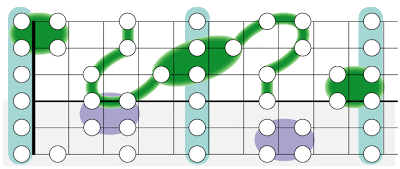
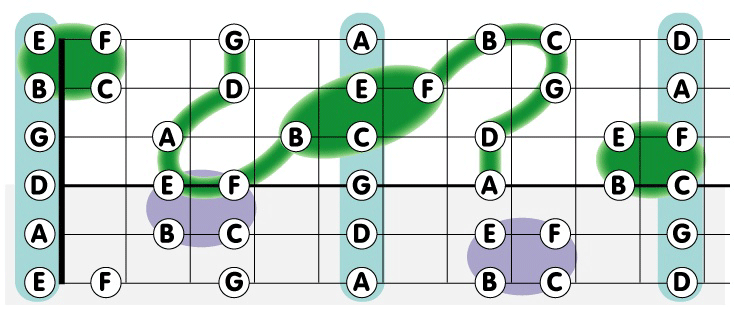
It's recognizable ... once you see it. The image below is an expression of the symmetry of the guitar fretboard I call The Spiral Galaxy Pattern The essential elements are the clusters of half-steps, the natural tone axis positions and the central spiral pattern which connects the remaining note positions.


An animated version of the pattern can be seen here.


But unfortunately, it's invisible on the guitar. You have to imagine it as you play. When you do, finding your way around the fretboard becomes almost as easy as finding notes on the piano. And the logic of the pattern conforms nicely with standard music notation, which is the goal.

When you have a pattern in your mind, you can find your way around better. Using tablature is a little like having a map with nothing but a grid and no geographical features. You know the latitude and longitude of each location, but you can't see the roads or the land masses and the oceans.

Without a picture of the 'geography' of the fretboard, you are wandering aimlessly. With that picture, you are communicating with the guitar and it is communicating with you. The journey becomes the destination.

Fretography challenges the norm in saying that the fretboard begins in the middle, not at the open strings. There's a good reason for this. It's because, if you start in the middle it gets easier faster than if you start with the open strings.

The conventional bias toward learning the guitar from the open strings first, then moving up incrementally has understandable origins, and it's clearly the best way to learn un-fretted instruments like the cello and violin, since, without frets, the only 'fixed' tones are the open strings. When the open string is the only absolute reference point for pitch on each string, every note you finger on a fretless instrument has to be learned in reference to the open string. On the guitar this matters not at all.

Since the frets take care of the intonation of each note you play on the guitar, you don't have to worry that your finger is exactly, precisely, in the perfect spot, as long as it's next to the correct fret on the correct string. If you're playing a cello or violin, then finger position is absolutely critical.

So why start with the open strings? I believe that the standard method is an anachronism which is long overdue for an upgrade.


Monday, July 26, 2010

What is Fretography ?


The word Fretography was coined by Mark Newstetter as the name of a system of mapping the guitar fretboard. As a guitar teacher, Mark felt that there was something missing from the available guitar study materials and methods. While there are plenty of diagrams to be found showing numerous scales and chords, there just wasn't a system of connecting the standard Diatonic system of music with a set of diagrams that add up to provide the student with a complete and consistent map of the note patterns of each key as a whole.

In other words, rather than merely putting together a series of diagrams of chords and scales which are learned one by one, Fretography approaches the fretboard as a whole right from the start. This gives the student an iconic picture of the whole system of notes of every key which beginners and advanced players alike find extremely useful in finding their way around the fretboard.

Many guitar students struggle to understand how each scale and chord they learn are related to each other in a musical key. The very concept of keys is difficult enough for the beginner and is not made any easier by the usual piecemeal approach to fretboard patterns.

The fact is, there are important 'landmarks' on the fretboard which are completely overlooked in some methods and only given token significance in others. In Fretography, these landmarks given the attention they deserve; they are assigned names which correspond with their significance in standard music theory.

For instance; there are three places in the system where there is a note on each string at a particular fret. The open strings (EADGBE), the 5th fret (ADGCEA) and the 10th fret (DGCFAD). The 12th fret notes are the same as the open strings an octave higher, so it can be thought of as theoretically the same place.

Fretography gives each of these positions a name. EADGBE is the 'Phrygian Axis', ADGCEA is the 'Aeolian Axis' and DGCFAD is the 'Dorian Axis'. These names are based on the diatonic modes which stem from the top and bottom note of each position in the key of C: E = Phrygian mode (3rd step of the key), A=Aeolian mode (6th step), and D = Dorian mode (2nd step). These three Axis positions are found in all twelve keys and define the fret positions based on the 3rd, 6th and 2nd step of each key.

At first glance, the remaining notes of the key seem to be spread around in a random pattern. In fact there is a very precise symmetry in the pattern, but it is not immediately obvious. Fretography makes sense of the apparent disorder. After identifying the three axis positions, other landmarks are mapped and named.

Imagine trying to get from place to place in an unfamiliar city without a map that shows the overall boundaries of the city. Imagine having a map with no names for neighborhoods or streets. This is in fact how most methods approach the fretboard. Fretography assigns logical names to the various landmarks, patterns and zones of the fretboard which relate directly with conventional music theory so you have a dynamic way of learning how each scale and chord fits in with the whole of music theory. This ultimately makes it easier to learn music as well as improvise.


All contents of this blog are © Mark Newstetter