Monday, March 2, 2015

Superzone 3rds

There are two "Superzones" on the fretboard; the Phrygian and the Aeolian. In any key, the Phrygian Superzone  runs from the Phrygian Axis to the Aeolian Axis – that is; the fret position on which the notes on the 1st and 6th string are the 3rd key degree (Phrygian) and the 6th key degree (Aeolian). In the key of E, for instance, the Phrygian Axis is the 4th fret because G# is the 3rd key degree of that key.

Below is a diagram of all of the 3rds within the Phrygian Superzone in the key of E ...
Major 3rds are shown as green, minor 3rds are amber. Notice the minor 3rds in the "3rd rail" (the 2nd and 3rd strings) are the same shape as the major 3rds everywhere else.


... Phrygian Superzone 3rds, ascending and descending


Now lets look at the Aeolian Superzone, this time we're in the key of B. In this key the Aeolian Superzone occupies the same fret span as the Phrygian Zone/Key of E in the above example. Compare the two patterns ...

... Aeolian Superzone 3rds, ascending and descending


You may want to focus on the positions of the major 3rds (I, IV, V) in each of the patterns. Notice in the Phrygian zone, that lower five major 3rds form a symmetrical sequence starting with A Major: IV - V - I - IV - V. See how central the V - I - IV grouping is.

In the Aeolian zone there are four major 3rds in the lower group, aligned in pairs starting with B Major: I - IV - V - I.

Look for the groupings of minor 3rds as well and practice them, and the major 3rds independently of one another. Be careful with your fingering so that you can feel the shapes of the double-stops as you play. Major 3rds may, at one time or another, be fingered 1-2, 2-3, or 3-4. Minor 3rds are fingered 1-3 or 2-4 outside the "3rd rail" (the 2nd and 3rd strings)  and 1-2 or 3-4 in the 3rd rail.


All contents of this blog are © Mark Newstetter

Sunday, February 22, 2015

Revisiting the VII Zone as an Arpeggio Zone

The VII Zone is one of two fretboard positions which require no hand shifts. It contains a full two octave range in the Locrian (VII), Ionian (I) and Dorian (II) modes. Shown below in the key of C, it is broken into two arpeggio paths, the blue-green path is treated as the primary line running from B on the 6th string to D on the 1st string. The secondary grey line runs from the Tonic (C) on the 6th string two octaves to the 1st string tonic. The C Major 7th (tonic) chord running from the 4th to the 1st string is the most prominent aspect of the overall pattern.

Notice that any three consecutive notes in each line comprise triads. The notation below the diagram shows how these extended arpeggios can be played as a series of triads.


The Leading tone rooted triad series (blue-green line) played two different speeds, ascending and descending.

... The Leading Tone (7th fret) Arpeggio


Next you see the same arpeggio pattern with the visual emphasis reversed;

The tonic arpeggio in the VII zone has one less note than the leading tone run; eight as opposed to nine. You may find that the different numbers of notes and the different fingering present different rhythmic possibilities. For instance, the Tonic 3rd sound clip below begins on an upstroke. Play these patterns using alternate direction flat-picking. Down/Up/Down/Up/ etc.
... The Tonic (8th fret) Arpeggio


Below are the two versions of the arpeggio pattern side by side;


VII Zone Arpeggio Scale

Ascending triads (root-3rd-5th); B dim, C maj, D min, E min, F maj, G maj, A min, B dim, C maj, D min, E min, F maj, G maj. Reverse to descend.

If you click on any image you will see full screen versions of the images in this post which you can compare by toggling using the arrow keys on your computer.


All contents of this blog are © Mark Newstetter

Monday, February 9, 2015

Moveable 3rds with Bass Drone

3rds riffs add a lot to any musical vocabulary. In this blog we've looked at a number of ways to approach 3rds on the fret board. This exercise comprises the first four 3rds in the key of E  (E Major, F# minor, G# minor, A Major) with the repetition of a fingered E in the bass.
Because there are no open string in this riff, you can move it to other keys, but it must be played using the same strings as shown. Notice that the bass note (5th string, 7th fret E) is played with the 4th, 3rd, 2nd and 1st fingers in consecutive order while the 3rds double stops begin with the 1st and 2nd fingers and end with the 3rd and 4th (E Major and A Major). The 1st and 4th fingers play both of the minor 3rds (F# and G# minor).

Play slowly and pay careful attention to the fingering.

It should sound something like this, played ascending and descending;


All contents of this blog are © Mark Newstetter

Wednesday, October 1, 2014

Up and Down

The image of the guitar above is positioned essentially as you would see it holding it in playing position.

Perhaps one of the worst habits you can acquire in your pursuit of guitaristic fluency is connecting the idea of "up" and "down" on the fretboard with anything other than pitch.

It has nothing to do with how close a particular string is to the floor or ceiling.Think of how the same terms – up and down – are applied on the piano, an instrument who's lowest note is the same distance from the floor as its highest. Think of the fretboard as if the floor and ceiling of the room you're in are not musical directions. They aren't. Up can only mean "Up in pitch." in music – not "Away from the floor of the room I'm sitting in."

If you don't get this idea out of your head you will be plagued for life, confusing UP and DOWN on the fretboard. You will think "up" but the note will get lower. Is this what you want your brain to deal with when you're playing?

If you're still reading, your answer is "no."

If course, although this truth applies to the fretboard, the movements of the right hand and arm are another story. A down-strum or down-pick does refer to the directional movement across the strings made by the right hand and arm.

Yes – it's sort of schizoid. But the right and left hands on the guitar are not living in the same world. Their reference points are different. The right hand is not concerned with the grid of the fretboard (much) and the left is not thinking about gravity (much).

All these factors have to exist in harmony ... and rhythm. Just as the right hand fingers are named and the left hand fingers are numbered, the left and right sides have to deal with up-and-down in different ways.

My basic way of thinking about this is that gravity (floor to ceiling motion) is the exception made for the strumming arm/hand when it's strumming.

A trickier problem is that the right hand almost always goes from a lower to a higher note as it gets closer to the floor. A downstroke rises in pitch ... an upstroke goes from high to low.

Does all this matter?

What matters is that – as a guitarist – you are 100% clear when you think about the concepts of "up" and "down" and that it is also clear to others. If you are used to referring to notes using physical, rather than musical reference points, you may, at some point, find yourself telling the keyboard player in your band something like "... I slide up the neck from G to A ... a 7th lower." You won't likely notice the keyboardist roll their eyes and you won't hear them thinking "... um ... yeah ... sure, dude ... whatever you say."

"... lower, up the neck" seems like an oxymoron to me.

As for strumming. The piano player watching you strum your guitar may need to know if your playing a certain beat on an upstroke or a downstroke, but it's more likely they want to know if you're going to arpeggiate the chord ascending or descending, so I say; lead with pitch.

Up and down are first and foremost musical terms when you're talking about music, they refer primarily to pitch, not physical direction.


All contents of this blog are © Mark Newstetter

Thursday, August 7, 2014

Inner Orbit Arpeggio

The notes of the "Orbit Pattern" in the previous post can be played in a smaller pattern I like to call the "Inner Orbit"
Notice that the green and orange forms contain the same notes and comprise a symmetrical pair. The pink and blue 'L' shaped patterns and gray elliptical half-step clusters are included to reinforce the overall symmetry.

Each half of the Inner Orbit can be played in a single hand position since they each span four frets. Use the fingering in the notation below the diagram.


All contents of this blog are © Mark Newstetter

Sunday, May 25, 2014

Orbit Pattern

Here's on of my favorite exercises. You can cover most of the fretboard with a circular, repeating arpeggio comprising the notes G B D F A ascending, and A F D B G descending. When played as shown in the diagram — in the key of C — the same notes can be played in a symmetrical arrangement with the 5th fret at the center.

Notice that you can play G A B D F A starting with the 4th finger on the 5th fret of the 4th string (purple), but you may also start with the 1st finger on the same 5th fret 4th string G and move to B on the same string with the 4th finger, ascending from there through D F and A, yielding the same arpeggio (aqua).

There are actually 3 triads in this pattern; G major (GBD), B diminished (BDF) and D minor (DFA)

Name the notes as you play them. 


Footnote: 

Electronics geeks may notice that this pattern bears a resemblance to the hysteresis loop; a pattern which shows the magnetic induction of a ferromagnetic substance (as ordinate) against the external magnetic field. Whatever that means. 

Anyway, here's an hysteresis loop;


and here:
http://en.wikipedia.org/wiki/Hysteresis

The similarities between these patterns is an interesting coincidence; hysteresis is a part of the science of sound engineering and you'll see it in discussions of the electronics of guitar effects pedals and the like. So although the only connection between the arrangement of these notes on the fretboard and the science of electromagnetism is graphic geometry it makes me wonder if the shape of things isn't actually more profound than we often think.


All contents of this blog are © Mark Newstetter

Monday, October 7, 2013

The Language of the Diatonic Guitar

Sources of confusion in any endeavor must first be identified before the confusion itself can be dealt with. If you find the guitar fret board confusing; why? If you are confused by basic western music theory concepts, then it's likely that same confusion will make its way into your study of the guitar.

You may think that the concepts and terminology of music theory are too difficult to bother with, but remember that — in the western diatonic system of music, which is what you are working with if you play the guitar (whether you know it or not) — fundamentally there are only 12 major keys and only 7 notes in each key. Think of it like the 12 months of the year and the 7 days of the week. These are not huge numbers.

The following terms are essential concepts in diatonic theory;

Tonic, Supertonic, Mediant, Subdominant, Dominant, Submediant, Leading Tone

... They are the Scale Degrees. They are, more or less, equivalent to the following;

Do, Re, Mi, Fa, Sol, La, Ti ... 

I, II, III, IV, V, VI, VII ...

C, D, E, F, G, A, B ...


Here are simple definitions;

Tonic -  The tone upon which a key is based. Note number I. C in the key of C major.

Supertonic  - The tone a whole step above the tonic. Note number II. D in the key of C major.

Mediant - The tone a third above the tonic. Note number III. E in the key of C major.

Subdominant - The tone a 4th above the tonic. Note number IV. F in the key of C major.

Dominant -  The tone a 5th above the tonic. Note number V. G in the key of C major.

Submediant -  The tone a 6th above the tonic. Note number VI. A in the key of C major.

Subtonic - The tone a minor 7th above the tonic as well as the same note a whole step below the tonic. Note number bVII. Bb in the key of C major.

Leading Tone -  The tone a major 7th above the tonic as well as the same note a half step below the tonic.  Note number VII. B in the key of C major.

Notice that there are two 7ths; the Subtonic and the Leading tone. The importance of this distinction becomes clear, for instance, when you switch from playing a major key love ballad or folk song to playing a raunchy blues based riff. The major 7th (Leading Tone) is the norm outside "blues based" music, whereas the Subtonic is the norm in blues. This is a gross simplification, but it should illustrate the concept.

Hierarchies ... The Tonic and the Dominant are the landmarks in the system — Roman numerals I and V, respectively. You are already familiar with these two tones. Play any typical major barre chord, G major rooted on the 3rd fret of the 6th string, say. 


The lowest pitched note is the root of the chord, the next note up in pitch is the 5th. If you are in the key of G this G barre chord will the the Tonic Chord and the root and 5th of the chord will also be the Tonic and Dominant tones of the key.

If you play a G7th by releasing your 2nd finger and moving your 4th finger to the 6th fret of the 2nd string, you are playing what is also known as a "Dominant 7th" chord. This is not the same as a "Major 7th" chord. The difference between the G major, G Dominant 7th (usually referred to as G7th) and the G Major 7th chords is seen in the diagram which follows;


Each of the chords above have their own story to tell about where they come from and how they like to be used.

G Major chord


G Dominant 7th chord


G Major 7th chord


The G Major chord is a triad. It comprises three tones: G-B-D,  though there are three instances of the Root (G), two 5ths (D)  and one 3rd (B) amounting to six notes. This chord could be the Tonic chord in the key of G, the Subdominant chord in the key of D, or the Dominant in the key of C. When a 7th is added to the triad, it will be either a G Major 7th or a G Dominant 7th depending on which key degree it is positioned.


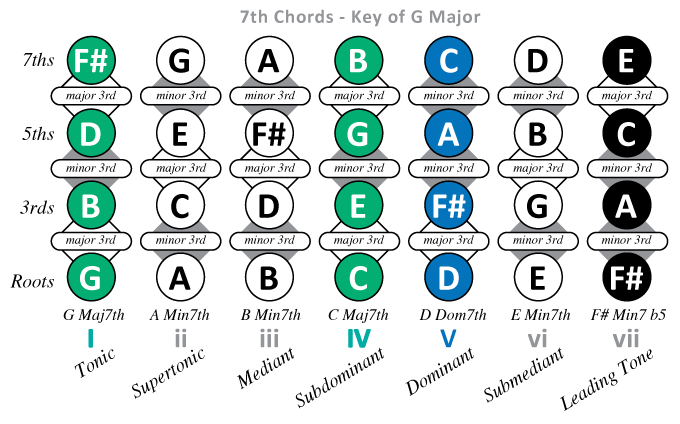
If a 7th chord is rooted on the Tonic (I) or the Subdominant (IV) it will be a Major 7th chord. If it is rooted on the Dominant (V), then it will be a Dominant 7th chord. This is true in every diatonic major key. It works this way because of the distribution of major and minor thirds within the key;
Study the diagram above carefully. Notice that the I and IV chords have the same interval structure of major and minor 3rds. Notice how the interval structure of the V chord differs from the I and IV.

The remaining chords are three "Minor 7ths" (ii, iii and vi) and a "Minor 7 flat V" (vii) — also known as a "Half Diminished" chord. 

Here are the 7th chords of the key of G major;

And here are the 7th chords of the key of D major;

The structure of each chord is actually only a starting point. For instance; although the I and IV chords are the same internally, their different positions in the key will potentially lead to differing harmonic and melodic possibilities when improvising around each of them. 

All contents of this blog are © Mark Newstetter